
Turkey Introduces New Machinery Safety Regulation What Importers and Foreign Manufacturers Need to Know Before January 2027
Turkey has adopted a regulation aligned with EU 2023/1230 that replaces the 2006/42/EC framework from 20 January 2027
Written by Veyis Taskin, Founder, TransparentFT
Published: 16 October 2026. Updated 2026. Based on the Machinery Safety Regulation (2023/1230/EU) published in Official Gazette No. 33402 on 16 October 2026.
Turkey published a new Machinery Safety Regulation (2023/1230/EU) in the Official Gazette on 16 October 2026. It updates product safety, conformity assessment and documentation rules for machinery and related products. Most provisions apply from 20 January 2027, when the current Machinery Safety Regulation (2006/42/EC) is repealed.
This guide is written for foreign manufacturers, exporters and companies arranging machinery shipments into Turkey. It covers what changes, which products are in scope, what importers are responsible for, and how shipments arriving around the transition date should be handled.
What This Guide Covers
- Timeline: The two-stage entry into force and what applies from 20 January 2027
- Scope: Which machinery and related products are covered, and which are excluded
- CE marking and documentation: Declarations of Conformity, technical files and digital instructions
- Partly completed machinery: Declaration of Incorporation and module-based projects
- Notified bodies: When third-party certification is and is not required
- Importer obligations: What the Turkish importer must verify before market placement
- Transition rules and TAREKS: How existing certificates and import inspections are affected
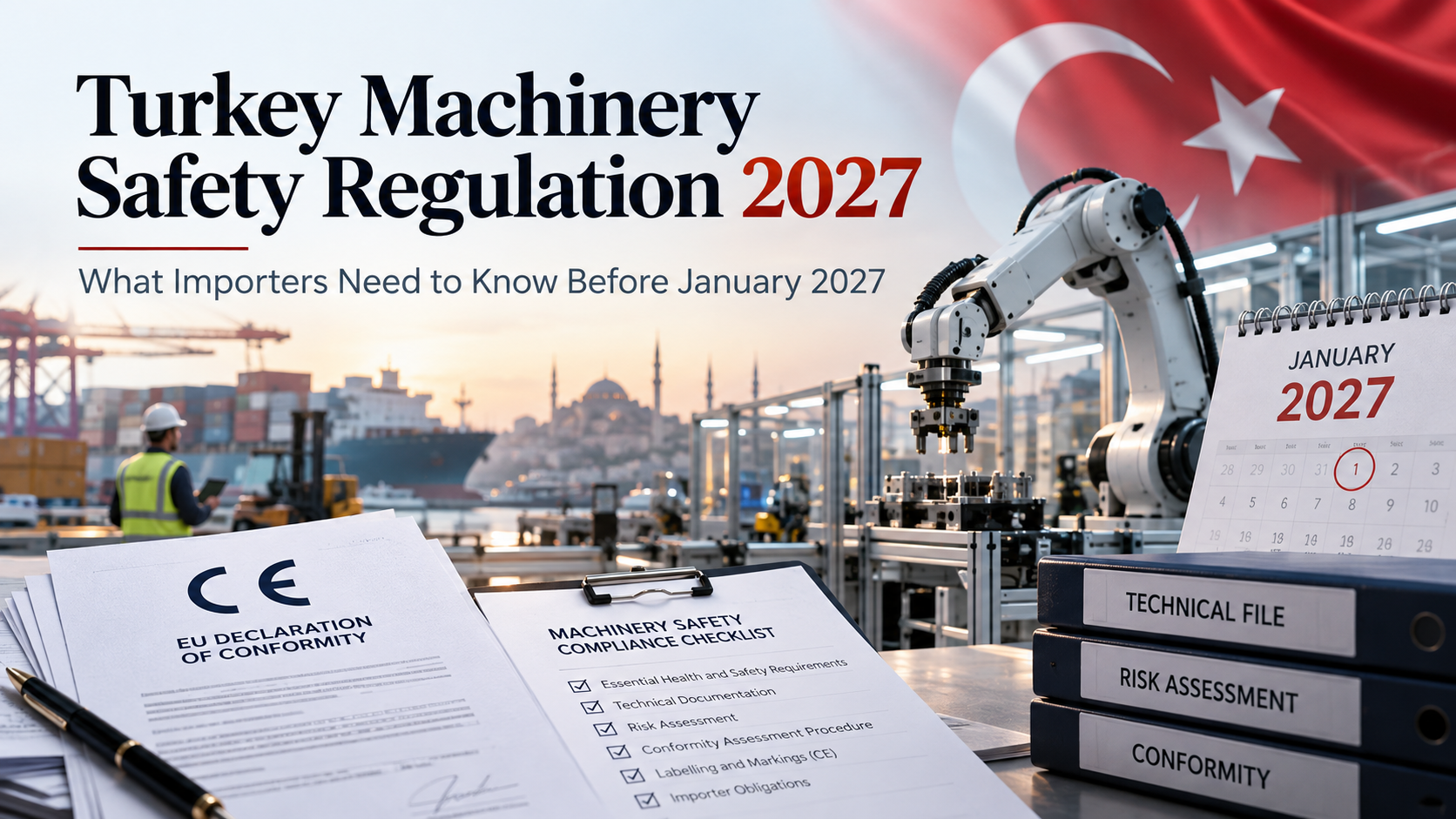
When Does the New Machinery Safety Regulation Take Effect?
The regulation was published in Turkish Official Gazette No. 33402 on 16 October 2026 by the Ministry of Industry and Technology. It aligns Turkish machinery safety rules with Regulation (EU) 2023/1230 and comes into force in two stages.
16 October 2026: Definitions, scope, notified-body arrangements and transitional measures entered into force on publication.
20 January 2027: The remaining provisions apply and the previous Machinery Safety Regulation (2006/42/EC) is repealed.
Machinery first placed on the Turkish market from 20 January 2027 will generally need to meet the new requirements. Any shipment planned for early 2027 should have its conformity documents reviewed well before dispatch, because a declaration prepared under the old framework may not be accepted for goods placed on the market after the cut-off.
Which Products Are Covered?
The regulation applies to machinery and to several categories of related products:
- Industrial and manufacturing machinery
- Interchangeable equipment
- Safety components
- Lifting accessories
- Chains, ropes and webbing used for lifting
- Removable mechanical transmission devices
- Partly completed machinery
Some product groups are excluded, including specified electrical and electronic equipment, transport equipment and products governed by separate regulatory frameworks. Qualifying information technology equipment that falls under the applicable electrical equipment or radio equipment legislation, for example, is outside the Machinery Safety Regulation. Servers, switches and similar data centre equipment are normally assessed under those other frameworks.
Scope has to be checked product by product. Not every piece of electrical or industrial equipment falls within the regulation, and the answer often depends on the product's main function and how it is supplied. The same discipline applies to GTIP classification, which drives the import controls attached to the shipment.
CE Marking and the EU Declaration of Conformity
Machinery and related products within scope must meet the applicable essential health and safety requirements before they are placed on the market. The manufacturer follows the relevant conformity assessment procedure and issues an EU Declaration of Conformity.
Depending on the product, the compliance file can include:
- EU Declaration of Conformity
- Technical documentation
- Risk assessment records
- Applicable harmonised standards
- Product identification and manufacturer information
- Operating instructions and safety information
- Notified-body certification, where required
A CE marking on the nameplate does not prove that every documentation and conformity requirement has been met. In practice, the most common problem we see is a declaration that does not match the model, variant or configuration actually being shipped. Importers should check that the declaration and supporting files correspond to the goods on the commercial invoice.
Updated Technical Documentation and Digital Instructions
The regulation updates the rules on technical documentation, risk assessment and product safety information. Manufacturers must assess hazards across intended operation and reasonably foreseeable use.
Digital documentation and operating instructions are permitted, subject to specific accessibility and availability conditions. This does not mean all safety information can be supplied digitally without restriction. Each product needs to be checked against the provisions on access to instructions and on safety information that must remain available.
For machinery imported into Turkey, the applicable Turkish-language requirements must also be met.
Special Requirements for Partly Completed Machinery
The regulation distinguishes complete machinery from partly completed machinery intended to be incorporated into another machine or assembly. Partly completed machinery has its own documentation set:
- EU Declaration of Incorporation
- Assembly instructions
- Relevant technical documentation
- Identification and traceability information
This matters most on international projects where equipment arrives in separate modules or as components shipped at different times. A declaration prepared for a complete machinery system should not be treated as covering every component imported on its own. Each consignment needs documentation that matches what is physically in it.
Common Assumption
Every machine now needs a notified-body certificate
CE marking alone is enough at the border
Goods made before 2027 are automatically covered by the old rules
What the Regulation Says
The route depends on the category and Annex I listing
Declarations and files must match the actual product
The market-placement date and conformity status decide
Is Notified-Body Certification Mandatory for All Machinery?
No. The regulation does not introduce a universal requirement for third-party certification of every machine.
The conformity assessment procedure depends on the machinery category, whether it appears in Annex I, and the relevant assessment conditions. Some products qualify for manufacturer-led conformity assessment. Others require a notified body. Importers should confirm which procedure applies before requesting a third-party certificate or relying on one supplied by the exporter.
Importer Responsibilities Under the New Regulation
The regulation sets out specific duties for importers placing machinery and related products on the Turkish market. Before market placement, the importer must verify that the manufacturer has completed the required conformity assessment and prepared the necessary documentation.
Verify CE marking and conformity documents. Confirm the marking is present and the Declaration of Conformity or Incorporation is complete and matches the product.
Ensure instructions travel with the product. Instructions and safety information, including Turkish-language requirements, must accompany the machinery.
Provide importer identification. The importer's name and contact details must be shown as required for traceability.
Keep documentation available. Required records must be held for inspection by the market surveillance authority.
Protect compliance in storage and transport. Handling conditions must not compromise the product's conformity.
Cooperate and correct. Work with the competent authorities and take corrective action when non-compliance is found.
These duties are especially relevant for foreign manufacturers that sell into Turkey through a local importer. Appointing an importer does not remove the manufacturer's own obligations. Both parties need to agree who holds which document, and who answers an authority request, before the goods are placed on the market. Because the importer's name goes on the product and on the declaration, the liability carried by a real local Importer of Record is not a formality.
What Happens to Machinery Certified Under the Previous Regulation?
The regulation includes transitional provisions so that products lawfully placed on the market under the old rules are not disrupted.
Machinery placed on the Turkish market before 20 January 2027 in conformity with the current Machinery Safety Regulation (2006/42/EC) may continue to be made available, subject to the transitional and market surveillance provisions. Existing EC type-examination certificates and approval decisions issued under the previous regulation remain valid until they expire.
These protections are not a general exemption for machinery manufactured or shipped before 20 January 2027. What counts is the date the product is placed on the Turkish market and its conformity status at that point. A machine built in 2026 but cleared and placed on the market in February 2027 needs to be assessed against the new framework. For shipments arriving during the transition, the applicable regime should be confirmed before customs clearance.
How Does the Regulation Affect TAREKS and Import Inspections?
TAREKS is Turkey's risk-based system for product safety and conformity checks on imported goods. Publication of the new Machinery Safety Regulation does not, on its own, create a new TAREKS procedure.
Import controls still depend on the applicable Product Safety and Inspection Communiqués (ÜGD Tebliğleri), the product's GTIP classification and the related administrative requirements. For machinery shipments there are two separate questions:
- Product conformity: whether the machinery meets the technical regulation, including CE marking, declarations, instructions and safety requirements.
- Import inspection: whether the product is subject to TAREKS registration, documentary verification or further inspection under the import legislation.
The two should be reviewed together before shipment. A mismatch between the declaration, the GTIP and the TAREKS application is one of the recurring causes of clearance delays in Turkey. Where a product is outside the scope of an inspection measure, a scope-exempt position may still need to be documented. Used machinery can also require separate second-hand import permission, which has its own timeline.
What Should Machinery Exporters and Importers Do Before January 2027?
Companies planning machinery shipments to Turkey should start reviewing their documents now rather than at the border. A practical checklist:
- Confirm whether the product falls within the new Machinery Safety Regulation.
- Review existing declarations against the requirements that apply from 20 January 2027.
- Check technical files, risk assessments and the standards relied on.
- Verify whether notified-body involvement is required.
- Review instructions, safety information and Turkish-language requirements.
- Confirm importer identification and traceability details.
- Check the applicable TAREKS and import inspection requirements.
- Assess each transition-period shipment individually.
Early coordination between the manufacturer, exporter, importer and customs representative is the cheapest way to find gaps. Fixing a declaration before dispatch takes days; fixing it while the cargo sits in a bonded warehouse costs storage and time.
Machinery Import Compliance Support in Turkey
Importing machinery into Turkey means lining up product conformity, customs procedures and product safety inspection. Inconsistent documents, incorrect classification or missing conformity information can trigger additional inspection and delay.
Transparent Foreign Trade (TransparentFT) acts as Importer of Record in Turkey and reviews documentation before shipment, including CE-related requirements and applicable TAREKS procedures. Foreign manufacturers without a Turkish entity can place machinery on the market through a non-resident Importer of Record structure, with TransparentFT appearing as the importer on the declaration and on the product. Where equipment is later re-exported, the same team handles Exporter of Record arrangements. For machinery shipments planned around the January 2027 transition, a pre-dispatch document review reduces regulatory uncertainty and avoids preventable import complications.
Conclusion
Turkey's new Machinery Safety Regulation brings Turkish requirements into line with Regulation (EU) 2023/1230 and replaces the 2006/42/EC framework from 20 January 2027. For most exporters the core obligations look familiar: CE marking, a Declaration of Conformity, a technical file and instructions. The risk sits in the details: matching declarations to actual configurations, handling partly completed machinery correctly, confirming the conformity route, and knowing which regime applies on the market-placement date.
Product conformity and TAREKS import inspection remain separate questions. Both should be settled before the goods leave origin, not tested at the customs declaration stage.
Official Source
Machinery Safety Regulation (2023/1230/EU): Official Gazette No. 33402, published 16 October 2026. Main implementation date: 20 January 2027.
Issuing authority: Republic of Türkiye, Ministry of Industry and Technology.
This article provides general regulatory information based on the legislation published on 16 October 2026. Product-specific conformity requirements, transitional provisions and applicable import inspection procedures should be verified before shipment.
Legal Name: TRANSPARENT DIS TICARET LTD. STI.
Trade Registry: Istanbul Chamber of Commerce (ITO) No: 317594-5
MERSIS No: 0859123223400001
Tax ID (VAT): 8591232234
After-Sales Service Certificate: SSHYB No: 84634 (TS 12498 Computers & Peripherals)
Trademark: TFTIOR Class 39 No: 2025 001248
Registered Address: Barbaros Hayrettin Pasa Mah. 2258. Sk. No: 23 / D: 5, Esenyurt, Istanbul, Turkey
ISO Certifications: 9001 · 14001 · 45001, IAS-accredited, IAF MLA signatory (QMS / EMS / OHSMS) · 10002 · 26000
Operating as Importer of Record for technology, telecom, machinery and regulated equipment imports into Turkey.
© 2026 TRANSPARENT DIS TICARET LTD. STI. All rights reserved. This guide is original proprietary content produced by TransparentFT based on direct operational experience with regulated imports and customs compliance in Turkey. Reproduction, rewriting, or redistribution in whole or in part without written permission is prohibited.
Frequently Asked Questions: Turkey Machinery Safety Regulation 2027
When does Turkey's new Machinery Safety Regulation take effect?
expand_more
Does every machine imported into Turkey need notified-body certification under the new regulation?
expand_more
Is CE marking enough to import machinery into Turkey?
expand_more
What documents are required for partly completed machinery?
expand_more
Can machinery certified under 2006/42/EC still be sold in Turkey after 20 January 2027?
expand_more
Does the new regulation change TAREKS inspections for machinery?
expand_more
Is IT equipment covered by the Machinery Safety Regulation?
expand_more
Can TransparentFT help with machinery imports during the 2027 transition?
expand_more
Planning a Machinery Shipment to Turkey?
If your machinery will be placed on the Turkish market around or after 20 January 2027, the declarations, technical file and instructions should be checked against the new regulation before dispatch. Partly completed machinery and multi-module projects need particular attention.
TransparentFT reviews scope, conformity documents, Turkish-language requirements and TAREKS applicability, then handles the shipment as Importer of Record so the goods are cleared and placed on the market under a responsible local importer.
Request a Machinery Compliance AssessmentAvailable in English and Turkish. Responses within one business day.
Related Turkey Import Resources
Compliance and Inspection
- TSE Scope-Exempt Filings Turkey: When out of scope still needs a filing
- What Goes Wrong with Turkey Imports: Common failure points and how to avoid them
- HS Code Classification in Turkey: How classification drives import controls
- TAREKS and the 2026 GTIP Split: Recent tariff change affecting network equipment
- Second-Hand Import Permits Turkey: Planning used equipment shipments
Importer of Record Services
- Turkey Importer of Record Overview: Full IOR service capabilities and process
- Non-Resident Importer of Record Turkey: Import without a local Turkish entity
- Real Local Importer of Record: Why importer liability matters
- Turkey Exporter of Record: Re-export and outbound shipments
- Global IOR Services (TFTIOR): Multi-country Importer of Record coverage