
TSE Scope-Exempt Filings in 2026 Out of Scope Does Not Mean Out of Process
A Practical Compliance Analysis for Importers Operating in Turkey
Written by Veyis Taskin — Founder, TransparentFT
Published: April 2026. Reflecting current TSE import conformity procedures and TAREKS scope-exempt filing practice.
Many importers still assume that if a product sits below a technical threshold, the TSE process simply does not apply. That assumption is becoming harder to defend in practice. This analysis explains what is actually shifting, why the procedural change matters more than the fee change, and what importers need to prepare before a shipment reaches Turkish customs.
What This Analysis Covers
- Why scope-exempt status is increasingly a filing, not an assumption: The procedural shift that changes how threshold-based products are handled
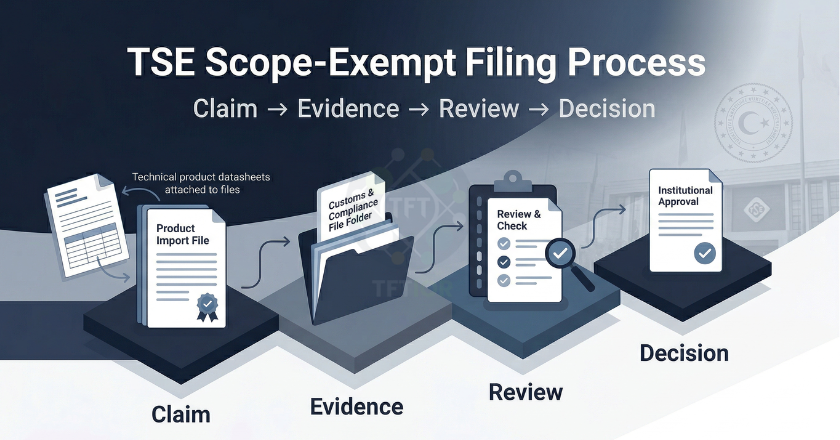
- The claim → evidence → review → decision sequence: What the TAREKS process actually requires from importers with scope-exempt products
- Model count as import strategy: How multi-model shipments affect cost profile and administrative complexity
- Where non-specialist import flows fail: Documentation gaps, inconsistent descriptions, and weak threshold logic
- What to prepare before shipment departure: Pre-filing discipline that prevents avoidable delays
What Is Actually Shifting in TSE Scope-Exempt Practice
The starting point is a distinction that many in the market still miss. Being outside the technical scope of a TSE requirement and being outside the process that surrounds that requirement are not the same thing. They are increasingly separate determinations, and the gap between them is where most compliance failures occur.
A product may be below a relevant technical threshold, outside the applicable product group, or clearly not intended to be captured by a specific TSE communique. In previous practice, that analysis often stopped at the importer's internal desk. The importer concluded that scope did not apply, recorded that conclusion, and moved on.
What is changing is that this internal conclusion is no longer the end of the matter. The importer's position must increasingly be filed, supported with technical documentation, and accepted by the competent authority through a formal administrative pathway. The official TSE import conformity page is publicly available, and TSE's own guidance makes clear that goods referred to TSE must proceed through the TAREKS system even where the importer believes them to be outside scope. The authority's acceptance is required. The importer's belief alone is not sufficient.
This is the core shift. Not a fee change. A procedural change.
The Sequence That Now Governs Scope-Exempt Positions
The practical consequence of this shift can be reduced to a simple sequence that operators need to internalize:
Claim
Importer states product is outside scope
Evidence
Technical documentation must support the position
Review
Authority assesses the file via TAREKS
Decision
Authority accepts or rejects the scope-exempt position
This sequence matters for one critical reason. The importer's view is not the final view. An operator may be entirely correct that a product falls below the relevant threshold. That technical correctness does not substitute for a properly structured file, submitted correctly, and evaluated by the competent authority. In a review environment, the importer's internal confidence has no procedural weight until the authority confirms it.
This is why experienced import operators treat scope-exempt positions as regulatory filings, not as informal comfort statements. The distinction is not academic. It affects pre-shipment timelines, documentation requirements, and what happens if the file is challenged.
A Hypothetical That Illustrates the Real Risk
Consider a product category where a threshold determines whether TSE conformity obligations apply. A machine below a given power rating might ordinarily be understood as sitting outside the relevant requirement. A machine above that rating would fall within it.
Under the older operating assumption, an importer seeing a below-threshold product would stop the analysis there. The product is below the threshold, therefore the obligation does not apply, therefore the process is light.
The operationally accurate position in 2026 is different. The relevant question is no longer only whether the product appears to sit below the threshold. The relevant question is whether the importer can file that position in a technically coherent way, support it with adequate documentation, and have the position reviewed and accepted through the actual control environment before the cargo becomes a problem at customs.
Below the threshold does not mean below institutional review. That distinction is the entire point.

Why This Pattern Is Familiar to Experienced Import Operators
For teams that work regularly with regulated product categories, this logic is not entirely new. There are other regulatory contexts where an importer takes the position that a product is outside a control framework, but still needs a formal pathway, supporting documentation, and a recorded result before the file is operationally clean.
The parallel is useful because it explains why experienced teams do not treat scope-exempt positions casually. The filing is not an afterthought to compliance. It is a component of regulatory positioning, and it carries the same quality requirements as any other compliance file.
This is especially true in environments where customs declarations, product descriptions, model breakdowns, technical data sheets, labeling, and shipment documentation all need to be internally consistent. Once a file enters a review environment, inconsistencies become operational problems. Weak product descriptions that might pass in a routine clearance become significant under scrutiny.
Where Filing Quality Matters Most
- Products near technical thresholds where scope is genuinely borderline
- Multi-model shipments where different products may sit differently relative to scope
- Equipment with specifications stated differently across different documents
- Shipments where customs description and product datasheet language diverge
- Goods entering Turkey through multiple customs offices or over multiple shipments
Where Non-Specialist Flows Typically Fail
- Lazy product descriptions that do not reflect threshold parameters clearly
- Missing or generic technical data sheets that cannot support a scope position
- Model groupings that increase administrative complexity without benefit
- Declarations filed without alignment between shipment documents
- No pre-shipment compliance review before the cargo is dispatched
The Cost Layer Matters, But the Evidence Layer Matters More
The recent attention on TSE scope-exempt filing costs is legitimate. A new cost layer changes budgeting for importers who previously assumed that below-threshold products had no associated compliance expenditure. That affects how shipments are planned, how they are quoted, and how project timelines are structured.
But the evidence layer is a more consequential development than the cost layer.
If a file is going to be reviewed to determine whether a product genuinely falls outside scope, then the technical basis of that file becomes critical. Product specifications, threshold logic, model differentiation, declarations, catalogs, labeling, and supporting documents all become part of the practical burden. A file may be correct in its underlying position but still fail in practice due to weak presentation, inconsistent wording, or structural gaps that create friction during review.
This is where many non-specialist import flows encounter problems. Not because the underlying scope position is wrong. Because the file is not prepared to the standard required by the review environment.
Model Count as Import Strategy, Not Just Catalog Management
One dimension of scope-exempt filings that many importers underestimate is the operational significance of model count.
Where filings are reviewed and assessed around model structures, the way a shipment is grouped, described, and documented can materially affect both the administrative profile and the cost structure of the case. This makes model planning relevant before a shipment is consolidated, not after.
An importer shipping multiple product variants with different specifications, power ratings, or technical parameters needs to consider how those distinctions are presented in the filing. Products that are described in a way that conflates different threshold positions may create filing complexity that was entirely avoidable with better pre-shipment planning.

The Commercial Consequence: Simple Imports Are Becoming Less Simple
This is where importers, procurement teams, freight forwarders, and exporters most frequently misread the situation.
The assumption is that if goods are not fully within the primary regulated category, the import process should be straightforward. Modern compliance environments do not consistently support that assumption. In a growing number of cases, the obligation shifts from full conformity to scope demonstration. The form of the obligation changes, but the obligation itself remains.
That distinction carries commercial consequences. It affects how shipments are planned and documented before departure. It affects how quotations are structured for projects involving regulated or borderline products. It affects who owns the file, and who is accountable when a scope position is challenged at customs. It affects the overall risk profile of a shipment that looked simple on paper.
The most operationally dangerous position is an importer who has already committed to a delivery timeline based on the assumption that a scope-exempt product requires no formal process. By the time that assumption is tested in practice, the options for corrective action are limited and expensive.
What Importers Should Take Away From This Development
The right response is not procedural anxiety. It is earlier and more disciplined pre-shipment preparation.
Importers working with products that may attract scope-exempt analysis should be asking the following questions before a shipment is dispatched:
Is the scope-exempt position based on a documented technical analysis, or is it an informal internal assumption that has not been tested?
Is the threshold logic clearly documented and aligned with the specifications stated in the shipment documentation?
Do the product specifications, customs declaration, and supporting technical documentation say the same thing about the relevant parameters?
Is the model structure of the shipment helping the filing, or is it creating unnecessary administrative complexity?
Is the submission being handled by a team that understands both Turkish customs practice and the technical review environment for scope-exempt positions?
The answers to these questions determine whether a scope-exempt shipment clears cleanly or becomes the kind of delay that should never have happened.
The New Discipline: Validity Is Not Enough Without Proper Filing
A scope-exempt position may be entirely valid. The product may genuinely fall below the applicable threshold. The technical analysis may be correct in every material respect. None of that is sufficient if the file is not prepared to the standard required by the review process.
Validity must be matched by filing quality. That is the practical discipline that this shift demands.
At TransparentFT, we follow TSE and TAREKS developments from the point at which they first affect operational import practice, because this is precisely where regulated imports become difficult for teams that are not close to the Turkish compliance environment. The cases that cause problems are not the obvious non-compliant shipments. They are the borderline files, the threshold-proximate products, and the shipments that were expected to be straightforward but were not structured to support the scope position they depend on.
As a compliance-driven Importer of Record in Turkey, TransparentFT manages this layer of the import process for foreign companies that cannot afford to leave scope-exempt positions to assumptions, generic brokers, or last-minute document improvisation.
Legal Name: TRANSPARENT DIS TICARET LTD. STI.
Trade Registry: Istanbul Chamber of Commerce (ITO) No: 317594-5
MERSIS No: 0859123223400001
Tax ID (VAT): 8591232234
After-Sales Service Certificate: SSHYB No: 84634 (TS 12498 Computers & Peripherals)
Trademark: TFTIOR Class 39 No: 2025 001248
Registered Address: Barbaros Hayrettin Pasa Mah. 2258. Sk. No: 23 / D: 5, Esenyurt, Istanbul, Turkey
ISO Certifications: 9001 · 14001 · 45001 — IAS-accredited, IAF MLA signatory (QMS / EMS / OHSMS) · 10002 · 26000
Operating as Importer of Record for technology, telecom, and regulated equipment imports into Turkey.
© 2026 TRANSPARENT DIS TICARET LTD. STI. All rights reserved. This analysis is original proprietary content produced by TransparentFT based on direct operational experience with Turkish import compliance procedures. Reproduction, rewriting, or redistribution in whole or in part without written permission is prohibited.
Frequently Asked Questions: TSE Scope-Exempt Filings in Turkey
What is a TSE scope-exempt filing in Turkey?
expand_more
Does a product below a TSE technical threshold require no filing?
expand_more
What documentation is needed to support a TSE scope-exempt position?
expand_more
How does model count affect the cost and complexity of a TSE scope-exempt filing?
expand_more
Can TransparentFT handle TSE scope-exempt filings as Importer of Record?
expand_more
Need Support With a TSE Scope-Exempt Filing?
If your shipment sits near a technical threshold, depends on a scope-exempt position, or involves multiple models that need to be documented coherently, the filing should not be left to assumptions.
TransparentFT supports importers, exporters, and project teams with structured scope-exempt positioning, technical document review, shipment-level compliance preparation, and practical coordination before delays start.
Contact Us to Review Your File Before SubmissionAvailable in English and Turkish. Responses within one business day.
Related Turkey Import Resources
IOR and Compliance Guides
- Turkey Importer of Record Overview — Full IOR service capabilities and process
- IOR Governance & Compliance Framework — Credentials, certifications, and compliance infrastructure
- Non-Resident Importer of Record Turkey — Import without a local Turkish entity
- Turkey IOR 2026 — Current import compliance environment
Equipment and Sector Guides
- Network & IT Equipment Import to Turkey — Switches, routers, and server compliance
- Data Center Equipment Import Turkey — End-to-end deployment guide
- Global IOR Services (TFTIOR) — Multi-country Importer of Record coverage
- Turkey IT Services & Logistics