
HS Code Misclassification in Turkey Why the Same Device Can Follow Two Completely Different Import Pathways
A Compliance Analysis for Importers of Network, Telecom, and IT Equipment
Written by Veyis Taskin — Founder, TransparentFT
Published: April 2026. Reflecting current Turkish customs classification practice and TAREKS screening procedures for network and telecom equipment.
If you are importing network or telecom equipment into Turkey without a local entity, HS classification errors are one of the most common causes of customs delays and unexpected compliance exposure.
In most international shipments, the HS code field is treated as an administrative box to fill. Vendors supply a code from their internal system, forwarders copy it onto the declaration, and the file moves forward. In Turkey, this approach generates a specific and well-documented category of import failure. The HS code declared at customs does not just determine tariff liability. It determines the regulatory pathway the shipment enters, which conformity checks are triggered, and whether the goods clear in days or weeks. For network and telecom equipment, the classification decision is a compliance decision with real operational consequences.
What This Analysis Covers
- Why HS classification is a regulatory gateway decision in Turkey: How the code declared at customs determines TAREKS screening exposure and conformity obligations
- The 8517 vs. 8543 classification gap: A documented scenario where the wrong code bypasses the correct regulatory pathway
- Why ECCN cannot substitute for HS classification: A persistent confusion that leads to incorrect customs declarations
- What proper classification actually requires: The functional and regulatory analysis that vendor systems and AI tools do not perform
- Where non-specialist import flows break down: The specific documentation and declaration failures that cause delays at Turkish customs
HS Classification in Turkey Is Not a Tax Decision
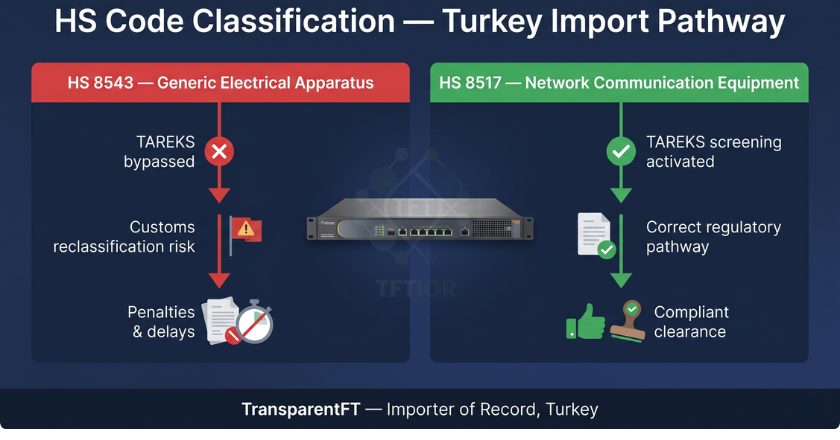
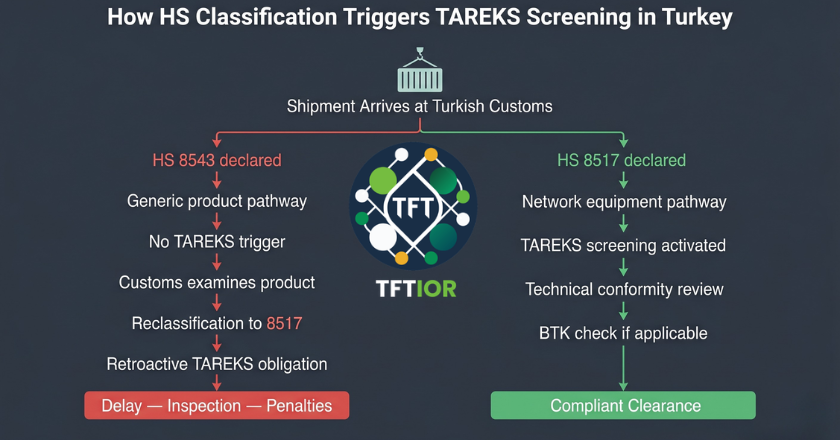
The assumption that HS codes primarily affect duty rates is accurate in many jurisdictions. In Turkey, it is incomplete. The Turkish import control framework uses HS classification as the entry point for a layered screening system. The code declared on a customs entry determines whether a product is referred to TAREKS (the Ministry of Trade's Foreign Trade Product Safety and Inspection System), whether technical conformity documentation is required, whether BTK type approval applies to telecom-capable devices, and whether specific import communique obligations are activated.
This matters because the consequences of a misclassification in Turkey are not limited to a tariff adjustment. A product declared under the wrong HS code can clear customs without triggering the controls that should have applied to it, which creates a compliance liability that surfaces later. Or it can be reclassified by customs during the inspection process, which places the shipment in a secondary review queue with timelines that are difficult to predict and impossible to recover commercially once the goods are already on the ground.
In practice, neither outcome is acceptable. And both are avoidable.
The Scenario: One Device, Two Classification Paths, Two Different Outcomes
A shipment that illustrates this clearly involves a network security appliance. The device is an IPS (Intrusion Prevention System) unit: a hardware product that inspects network traffic, identifies threat patterns, and acts on that analysis in-line. It is purpose-built for network security, physically installed into network infrastructure, and communicates over data links.
The vendor's internal system assigned HS 8543. The forwarder reproduced that code on the export documentation without modification. At first review, HS 8543 appears defensible. It covers electrical machines and apparatus not covered elsewhere. For a product that a non-specialist might describe as "specialized electronics," the code might pass an informal check.
It does not pass a proper classification analysis.
Vendor-Assigned Code
HS 8543.70
Other electrical machines and apparatus not elsewhere specified
- Generic fallback category
- Does not trigger TAREKS screening for network equipment
- Incorrect for devices with network communication function
- Creates reclassification risk at Turkish customs
Correct Classification
HS 8517.62
Machines for the reception, conversion, and transmission of data
- Covers routers, switches, firewalls, IPS devices
- Activates TAREKS screening in Turkey
- Correct regulatory pathway for network hardware
- Aligned with the product's actual network function
The IPS appliance transmits, receives, and processes data across network interfaces. That functional description maps directly to HS 8517, which covers machines for the reception, conversion, and transmission or regeneration of voice, images, or data. The subheading 8517.62 specifically captures network routers, switches, and comparable devices, including those with integrated security or traffic inspection functions.
The physical device has not changed. The customs outcome, regulatory exposure, and clearance timeline have.
What the Classification Gap Means in Practice at Turkish Customs
When an IPS appliance or any comparable network device is declared under HS 8543 in Turkey, two things can happen, and neither is neutral.
The first possibility is that the misclassification is not caught at entry and the goods clear. This appears to be a favorable outcome, but it is not. It means the product entered the Turkish market without the conformity and safety screening that Turkish import law requires for equipment of that type. The liability does not disappear because customs did not catch it. It is stored, and it reappears when the goods are inspected in use, when they are seized in a post-clearance audit, or when the Importer of Record faces questions about the accuracy of the original declaration.
The second possibility is more immediate. Turkish customs officers reclassify the product based on its actual technical description. This is a routine part of the customs examination process for network and telecom equipment. When a device described as an IPS appliance or a network traffic processing unit arrives under a generic electrical apparatus code, the discrepancy between the declared code and the product function is visible and creates a referral. The shipment moves into a secondary examination track, TAREKS screening is activated belatedly, and additional documentation may be required at a stage when pre-arranging it is no longer straightforward.
In either case, the classification error that appeared harmless at origin creates an operational problem at destination.
ECCN Is Not an HS Code and Cannot Substitute for One
The shipment in this scenario also carried an ECCN designation: 5A002, which classifies the device as a security and encryption-controlled item under US export control law. This designation is relevant and accurate for its purpose. It governs whether the export of the device requires a US export license, to which destinations, and under what conditions.
It has no role in Turkish customs classification.
ECCN and HS codes are determined by separate frameworks, answer separate questions, and are used by separate authorities in separate processes. The ECCN tells the US Bureau of Industry and Security how to control outbound movement. The HS code tells Turkish customs how to classify the goods for tariff, duty, and regulatory screening purposes. A product with ECCN 5A002 still requires independent HS classification analysis. Its export control status does not suggest, constrain, or determine its Turkish customs heading.
This confusion is common in shipments involving dual-use and security equipment, where export compliance teams and customs compliance teams may be operating with different documentation. The result is a declaration that is technically supported on the export control side but undefended on the classification side. Turkish customs examines the classification, not the ECCN.
How Classification Errors Enter the File
- Vendor ERP systems classify by product family, not by customs tariff function
- AI-assisted classification tools match keywords, not regulatory intent
- Forwarders reproduce vendor codes without independent review
- Export control documentation (ECCN) is incorrectly treated as a classification source
- Multi-function devices are classified on their primary commercial description, not their network role
Where the Problem Surfaces in Turkey
- Customs examination identifies a mismatch between declared code and product description
- TAREKS screening is activated after clearance is already expected
- Documentation required for TAREKS was not prepared pre-shipment
- BTK type approval is identified as applicable when goods are already at the port
- Post-clearance audit generates liability for an entry that appeared to clear cleanly
Why Vendor Classification Cannot Be Used Without Independent Review
Vendor HS codes are generated for vendor purposes. They are designed to support the vendor's own export documentation, customs filings, and internal systems in their home jurisdiction. They are not designed to be portable across destination markets, and they are not validated against the regulatory environment of the importing country.
This is not a criticism of vendors. It is a structural feature of how international trade documentation is produced. The vendor classifies for export. The importer must classify for import. Those are different determinations, even when the tariff schedule headings appear similar. In Turkey, the regulatory consequences attached to specific headings, particularly in the 8517 and 8471 families for IT and network equipment, are determined by Turkish import communiques that have no equivalent in the vendor's home market. A code that carries no particular regulatory significance in the US, Germany, or Singapore may trigger a substantive compliance process in Turkey.
The same point applies to AI-assisted classification tools, which have become widely used in freight and compliance operations. These tools perform keyword and description matching against tariff schedules. They identify the heading most consistent with the product description provided. They do not assess whether that heading carries regulatory obligations in the destination market. They do not evaluate the product's functional role in network infrastructure. And they do not account for Turkey-specific communique obligations that attach to specific headings. Their output is a starting point, not a declaration.
What Proper Classification Requires for Regulated Equipment
For network, telecom, and security equipment imported into Turkey, classification is a multi-stage analysis that covers more than tariff schedule matching.
Function
What does the device actually do in a network?
Network Role
Data transmission, security, standalone computation?
Regulatory Trigger
Which heading activates TAREKS, BTK, or communique obligations?
Declaration
Code declared with full accountability for the regulatory outcome
The functional analysis establishes what the device does: whether it primarily transmits and processes network traffic, whether it operates as a standalone computing unit, or whether its network interfaces are incidental to another primary function. That determination drives the classification heading.
The regulatory pathway analysis then assesses what that heading means specifically in Turkey. For HS 8517 headings, this includes identifying whether TAREKS screening applies under the current import communique, whether BTK type approval is required based on the device's radio or interface specifications, and whether any product-specific technical documentation must be prepared before the shipment is dispatched.
The declaration step is where the classification is committed. In a compliant import operation, the entity declaring the goods is the Importer of Record, and that entity assumes responsibility for the accuracy of the HS code. This is not a theoretical accountability. If the declared code is challenged by Turkish customs, the IOR responds. If the reclassification triggers additional compliance requirements, the IOR is responsible for resolving them. Classification is not an advisory function in this context. It is a commitment.
The Pricing Reality: What Classification Errors Actually Cost
The commercial argument for investing in accurate pre-shipment classification is straightforward, even before the compliance argument is made.
A shipment held at Turkish customs for reclassification and secondary inspection typically incurs port storage charges from the day the customs hold begins. For air freight, storage costs at Turkish cargo terminals accrue quickly. For sea freight, demurrage and detention timelines are governed by carrier terms that do not extend grace periods for compliance-driven delays. A shipment that sits for ten to fifteen days during an unexpected TAREKS referral can generate direct charges that materially exceed the cost of any pre-shipment classification review. And those direct charges do not include the downstream costs: missed delivery commitments, project timeline slippage, emergency re-procurement, and the operational disruption for the end client receiving the equipment.
Classification review costs are variable and depend on the product category, complexity of the technical documentation, and the number of line items involved. What they are not is comparable in magnitude to the cost of a customs delay for a regulated technology shipment. The pre-shipment investment is not a compliance overhead. It is a risk management decision with a straightforward return profile.
Factors That Affect Classification and Compliance Complexity
Product-Level Factors
- Multi-function devices with overlapping classification indicators
- Security and encryption-capable equipment (dual-use status)
- Integrated radio or wireless interface components
- Refurbished equipment with modified original specifications
Shipment-Level Factors
- Number of distinct product lines or model variants
- Consistency between commercial invoice, packing list, and technical specs
- Whether BTK type approval documentation exists and is current
- Whether prior shipments of the same product have customs history in Turkey
The Exporter of Record Dimension
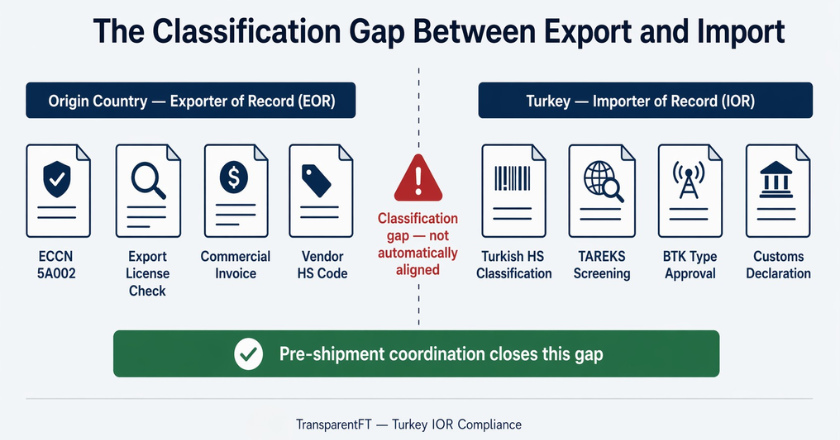
For shipments involving dual-use equipment or export-controlled technology, the classification question exists at both ends of the transaction. The Exporter of Record (EOR) in the originating country is responsible for the accuracy of the export classification, including the ECCN where applicable. The Importer of Record (IOR) in Turkey is responsible for the accuracy of the import HS classification.
These roles are sometimes held by the same party in simpler transactions, but for regulated technology shipments they are typically separated. The EOR manages export licensing, restricted party screening, and origin documentation. The IOR manages Turkish customs classification, TAREKS compliance, and post-clearance obligations. Where the EOR and IOR operate from separate organizations, alignment between the export documentation and the import declaration is not automatic. It requires explicit coordination before the shipment is dispatched.
In our experience handling regulated equipment imports into Turkey, the files that generate the most customs friction are precisely those where the export documentation and the import declaration were prepared independently, without a review step that checks consistency between them. The HS code assigned by the vendor, reproduced by the forwarder on the export side, arrives at Turkish customs as the declared import code, without anyone having assessed whether it is the right code for the Turkish regulatory environment. That gap is where classification errors enter the process.
What Importers Should Verify Before Dispatching to Turkey
For any shipment of network, telecom, or security equipment into Turkey, the following questions should be answered before the goods leave origin.
Has the HS code been determined by a functional analysis of the product, or has it been reproduced from the vendor's export documentation?
Has the declared heading been assessed for TAREKS screening exposure under the current Turkish import communique?
Does the device have wireless, radio, or telecom interface features that may trigger BTK type approval requirements in Turkey?
Is the product description on the commercial invoice and packing list consistent with the technical specifications that support the declared HS code?
Is the Importer of Record in Turkey positioned to respond if the declared code is challenged by Turkish customs during examination?
None of these questions can be answered after the shipment is in transit. Pre-shipment preparation is the only point at which the classification can be reviewed, corrected, and supported with the documentation required to defend it. Once the goods are at the port, the options for correction are limited and the costs of delay are already accumulating.
How TransparentFT Treats Classification
At TransparentFT, HS classification for regulated technology imports into Turkey is a compliance decision with legal accountability, not a data-entry task. We do not reproduce vendor codes without independent analysis. For network, telecom, and security equipment, that analysis includes a functional review of the product, an assessment of which Turkish regulatory obligations attach to the proposed heading, a check for BTK type approval exposure, and a consistency review between the technical documentation and the proposed customs declaration.
Where the classification requires pre-arranged TAREKS documentation or BTK approval coordination, we identify that requirement before the shipment is dispatched, not after it arrives at a Turkish port. This pre-shipment window is the only point at which the compliance structure can be set up properly.
As Importer of Record in Turkey, we assume formal responsibility for the classification we declare. That accountability is the reason our classification process is structured the way it is. A code we declare is a code we own.
If you are importing network equipment, security appliances, data center hardware, or regulated IT equipment into Turkey and you are not confident in the HS classification supporting your shipment, that is the specific question to address before departure. We are available to review the file.
TransparentFT does not provide HS code suggestions as an advisory output. We declare HS codes as Importer of Record and assume full regulatory responsibility for the outcome.
Legal Name: TRANSPARENT DIS TICARET LTD. STI.
Trade Registry: Istanbul Chamber of Commerce (ITO) No: 317594-5
MERSIS No: 0859123223400001
Tax ID (VAT): 8591232234
After-Sales Service Certificate: SSHYB No: 84634 (TS 12498 Computers & Peripherals)
Trademark: TFTIOR Class 39 No: 2025 001248
Registered Address: Barbaros Hayrettin Pasa Mah. 2258. Sk. No: 23 / D: 5, Esenyurt, Istanbul, Turkey
ISO Certifications: 9001 · 14001 · 45001 — IAS-accredited, IAF MLA signatory (QMS / EMS / OHSMS) · 10002 · 26000
Operating as Importer of Record for technology, telecom, and regulated equipment imports into Turkey.
© 2026 TRANSPARENT DIS TICARET LTD. STI. All rights reserved. This analysis is original proprietary content produced by TransparentFT based on direct operational experience with Turkish customs classification and import compliance procedures for regulated technology equipment. Reproduction, rewriting, or redistribution in whole or in part without written permission is prohibited.
Frequently Asked Questions: HS Code Classification for Network Equipment Imports into Turkey
Why does HS code classification matter for imports into Turkey?
expand_more
What is the difference between HS 8517 and HS 8543 for network equipment imports into Turkey?
expand_more
Does ECCN determine the HS code for customs purposes in Turkey?
expand_more
What triggers TAREKS screening for network equipment imports into Turkey?
expand_more
Can a shipment clear Turkish customs with an incorrect HS code?
expand_more
Can TransparentFT validate HS classification before a shipment is dispatched to Turkey?
expand_more
Need Classification Review Before Your Shipment Departs?
If you are importing network equipment, security appliances, or regulated IT hardware into Turkey and the HS classification was assigned by a vendor system, a forwarder, or an AI tool without a regulatory pathway review, that classification should be independently validated before the goods leave origin. Vendor or forwarder-assigned codes are not sufficient for Turkey.
TransparentFT provides pre-shipment classification review and full Importer of Record services for technology and telecom equipment imports into Turkey. We review the code, the regulatory exposure, and the documentation structure before the shipment is dispatched.
Contact Us to Review Your Classification Before DispatchAvailable in English and Turkish. Responses within one business day.
Related Turkey Import Resources
IOR and Compliance Guides
- Turkey Importer of Record Overview — Full IOR service capabilities and process
- IOR Governance & Compliance Framework — Credentials, certifications, and compliance infrastructure
- Non-Resident Importer of Record Turkey — Import without a local Turkish entity
- TSE Scope-Exempt Filings Turkey 2026 — When below-threshold products still require a formal process
Equipment and Sector Guides
- Network & IT Equipment Import to Turkey — Switches, routers, and server compliance
- Data Center Equipment Import Turkey — End-to-end deployment guide
- Global IOR Services (TFTIOR) — Multi-country Importer of Record coverage
- Turkey IOR 2026 — Current import compliance environment